← Back to blog
PlaybookPlaybook - Investors
The Family Office Operating System: 7 AI Steps for Managing a Complex, Multi-Asset Portfolio with a Lean Team
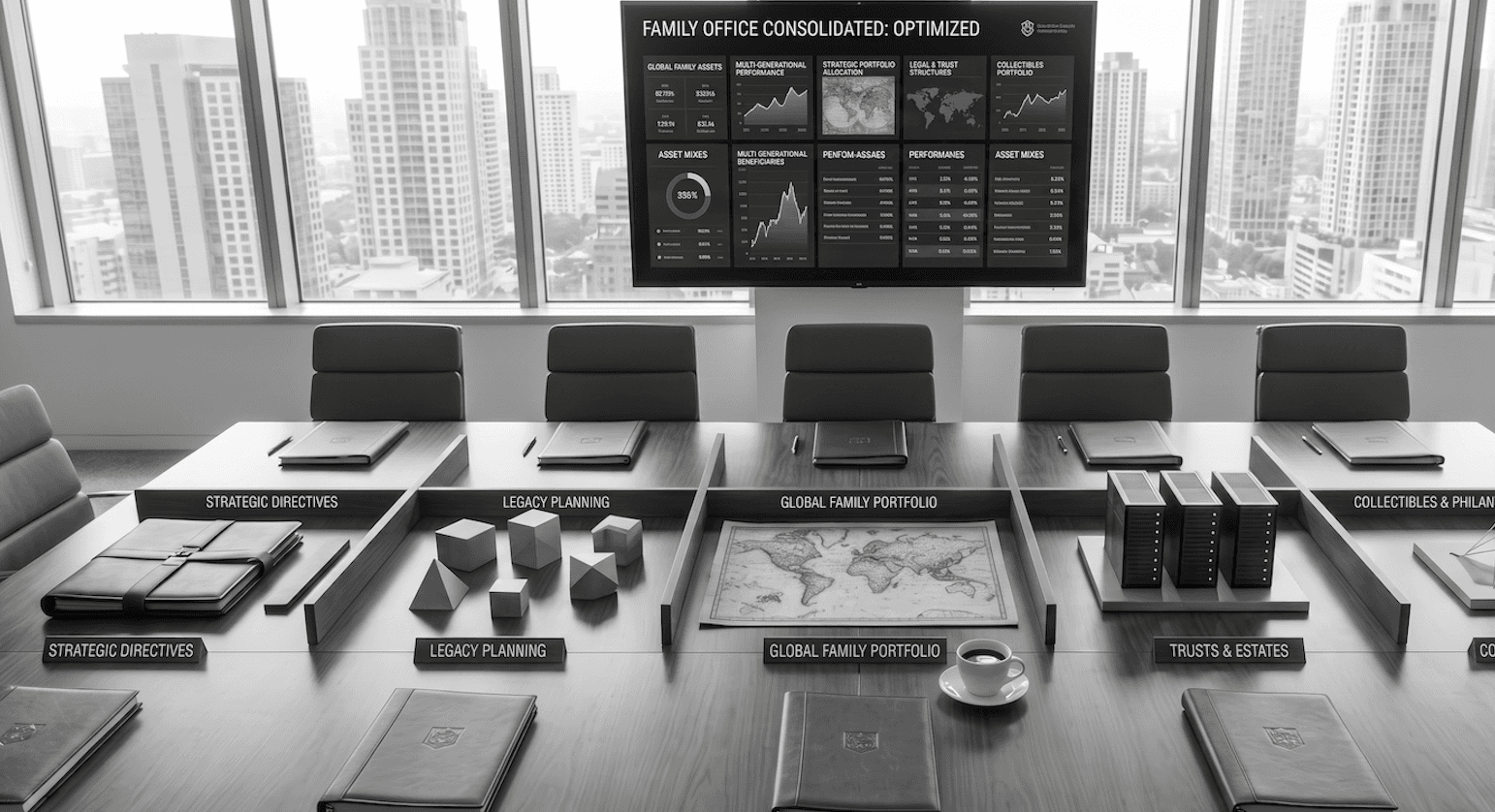
The Leanest Investors Managing the Most Complex Portfolios
The structural paradox of family office investing: portfolios of extraordinary complexity (direct PE, venture funds, real estate, credit, co-investments, operating businesses) managed by teams of four to eight. The same complexity at a pension fund would employ three to five times that headcount. The constraint isn't analytical capability. It's information flow. AI solves the information flow problem comprehensively. Here's how leading family offices are doing it.
40 funds. 40 different report formats. 40 different metric definitions. One analyst spending 3 weeks per quarter translating. Here's the workflow that eliminates the translation entirely.
Yesterday: A dedicated analyst spends the first three weeks of every quarter manually translating GP reports into a normalised spreadsheet: extracting DPI, TVPI, and net IRR into a master file, reconciling inconsistent metric definitions, and chasing late reports from GP administrators. The team's analytical capacity is committed entirely to a formatting exercise for one month of every quarter.
Today: Every GP report is forwarded to a dedicated Peripheral space for that fund. The platform extracts key performance metrics, normalizes them against standard definitions, and updates the fund's record automatically. Cross-fund comparisons become instant queries. The analyst's role shifts from translation to analysis: which GPs are showing the strongest DPI progression? Which funds have the highest concentration of companies approaching next financing milestones?
Tomorrow: Peripheral ingests GP reports the moment they arrive, regardless of format or delivery channel, and updates the normalized portfolio view in real time throughout the quarter rather than as a periodic batch exercise at quarter end.
Tools: Addepar · Allvue · Peripheral Fortress + Metrics
The best co-investment opportunities have 2 to 4 week windows. The families that can consistently move in 48 hours get the allocations. Here's how to always be one of them.
Yesterday: Co-investment evaluation requires assembling a team, scheduling review sessions, and conducting manual analysis across documents that arrived in inconsistent formats on a tight timeline. The evaluation takes two to three weeks. The best allocations go to faster-moving LPs. The family gets the deals that nobody else wanted on that timeline.
Today: Within two hours of receiving co-investment materials: upload to a Peripheral Project. The platform extracts key financial metrics, benchmarks against comparable transactions in the historical database, evaluates strategic fit against documented criteria, and flags risks for deeper investigation. By hour 24: a structured preliminary assessment for the principal: fit score, financial attractiveness, and the three outstanding questions. Conditional go/no-go that day.
Tomorrow: Peripheral maintains a continuously updated co-investment scoring framework that learns from each evaluation, refining fit assessments over time based on the family's actual investment decisions and outcomes.
Tools: PitchBook · Peripheral Projects + Claim Validation · CapIQ
Every GP pitch tells a great story about their track record. Here's how to verify it systematically before committing a single meeting hour.
Yesterday: New manager evaluation begins with the pitch meeting, where the GP presents a polished narrative about their track record. The investment team evaluates the narrative based on experience and market knowledge. Systematic validation of track record claims against external data rarely happens because it takes time nobody has.
Today: Before the first meeting: ingest the fund deck and track record schedule into a Peripheral Project. Run claim validation against PitchBook vintage benchmarks, public information about portfolio company exits cited in the track record, and analyst data for market size claims. The output is a list of the assertions most in need of verification, directing the in-person conversation toward the questions that actually matter rather than the questions the GP has rehearsed answers for.
Tomorrow: Peripheral maintains a living manager evaluation database, continuously updating each GP's track record assessment as new fund performance data, portfolio company outcomes, and market benchmarks become available throughout the relationship.
Tools: PitchBook · Preqin · eVestment · Peripheral Claim Validation
The highest-value output a family office investment team produces is a synthesized weekly view of the portfolio. Here's how to generate it in 2 hours rather than 2 days.
Yesterday: The principal brief is produced by an analyst spending one to two days aggregating news across 40 GP relationships and 15 direct investments, synthesising highlights, and formatting into a document. The process is high effort, frequently late, and often reflects what was easy to find rather than what was most material.
Today: Peripheral monitors all portfolio positions continuously: ingesting GP newsletters, company updates, news coverage, and market commentary. Weekly synthesis happens automatically. The investment team reviews the AI-generated brief, adds the context that only humans can provide (the phone call that revealed something the written report didn't), and calibrates emphasis based on the principal's current priorities. Heavy lifting: automated. Value-add: human.
Tomorrow: Peripheral delivers a personalized principal brief calibrated to the individual principal's stated priorities and current areas of focus, updating the emphasis dynamically as the portfolio and market environment evolve throughout the year.
Tools: AlphaSense · FactSet · Hebbia · Canoe · BlueFlame AI · Standard Metrics · Peripheral Insights
A family office that owns 30% of a B2B software company isn't a passive LP. It has board representation, strategic input, and operational engagement. The monitoring system needs to support all of it, at scale.
Yesterday: Direct portfolio monitoring is conducted company by company. The relevant team member reads each investor update individually, updates internal records manually, and prepares for board meetings through a separate review process for each company. Depth of engagement is limited by the number of hours available.
Today: Each direct investment has a dedicated Peripheral space calibrated to the family's role at that company. For actively engaged positions: deep operational KPI monitoring, full document archive, board prep briefs. For more passive positions: high-level financial monitoring and quarterly synthesis. Peripheral surfaces Insights ranked by urgency across all 15 companies simultaneously: the team reviews a unified feed rather than 15 separate monitoring processes.
Tomorrow: Peripheral automatically adjusts monitoring depth and alert sensitivity for each direct investment based on the company's current risk profile, board meeting proximity, and the family's evolving level of operational engagement.
Tools: Peripheral Spaces + Insights · Addepar · Visible.vc
A family office with 40 fund relationships and 15 direct investments owns positions in hundreds of underlying assets. Most have no clear picture of what those positions add up to. Here's how to get one.
Yesterday: Exposure analysis is conducted annually at best, using a manually assembled spreadsheet that aggregates fund-level data without visibility into underlying holdings. Concentration risks at the company or sector level are invisible until a material event forces a reckoning.
Today: Upload fund-level portfolio reports, capital account statements, and direct investment documentation into Peripheral. It reads across all of them simultaneously: surfacing underlying company holdings, sector concentrations, and geographic exposures invisible when each fund is viewed in isolation. If six funds each hold a material position in the same company, you know before it appears in a quarterly report. If 35% of your effective PE exposure is in B2B SaaS across funds and directs combined, you know before committing to the next co-investment in that space.
Tomorrow: Peripheral maintains a continuously updated look-through exposure map across the entire portfolio, automatically recalculating concentration risks as new fund reports arrive, new investments are made, and existing positions are marked up or written down.
Tools: Peripheral · Addepar · Allvue · Vestberry
K-1s from 40 funds arriving on 40 different schedules. PFIC statements. Foreign account filings. Offshore structure compliance. The annual compliance scramble is optional. Here's how to eliminate it.
Yesterday: Tax and compliance documentation is managed across email threads, shared drives, and in some cases physical files. At tax preparation time, the team spends weeks locating documents, reconciling what has and has not arrived, and organizing materials for the accountants. The process is reactive, error-prone, and creates audit risk through documentation gaps.
Today: A dedicated compliance workspace ingests all tax and compliance documentation as it arrives: K-1s, PFIC statements, foreign account filings, corporate governance documents. Documents are automatically categorized by type and tax year, with a real-time status tracker showing what has been received and what is outstanding. At tax preparation time, the accountants receive an organized, complete document set rather than a chaotic pile.
Tomorrow: Peripheral proactively chases outstanding compliance documents on behalf of the team, sending automated reminders to GP administrators and fund managers when expected documents have not arrived by their anticipated delivery date, and flagging escalations when deadlines approach.
Tools: Peripheral Fortress (compliance workspace) · Carta Tax · Orion
The most expensive thing a family office can lose isn't capital. It's the institutional knowledge that walks out the door when a key investment professional transitions. Here's the workflow that prevents it.
Yesterday: Institutional knowledge is stored in the heads of individual team members: the GP relationship context that took a decade to build, the history of every direct investment decision, the family's investment philosophy as informally understood by the current team. When team members transition, this knowledge is irretrievably lost or takes years to rebuild.
Today: Configure every team member's GP communications, investor updates, and deal correspondence to auto-forward to the family's shared Peripheral Fortress so institutional knowledge accumulates in a shared, searchable repository rather than siloed personal inboxes. When every communication is ingested, every investment decision documented, and every board meeting archived, the next generation taking on investment responsibility can access a complete, queryable record of the family's history and philosophy. The learning curve that typically takes 3 to 5 years compresses to months.
Tomorrow: Peripheral serves as the family's permanent institutional memory layer, continuously enriching the knowledge base as new decisions are made, new relationships are built, and new market knowledge is accumulated, ensuring that the organization's intelligence grows rather than resets with every leadership transition.
FINAL THOUGHTS
The family office operating system described here isn't a vision for the future: it's how the best-operated family offices are working today. The operational advantage compounds over time: faster co-investment decisions, better-prepared principals, more consistent GP monitoring, earlier identification of portfolio risks. The families that build this infrastructure aren't just managing their portfolios more efficiently. They're building an institutional capability that can survive generational transitions, adapt to changing complexity, and serve the family's investment objectives across decades rather than quarters. The technology is available. The workflows are proven. The question is when to start.
WHERE PERIPHERAL CONNECTS THE DOTS
Peripheral serves as the central platform across the entire article, ingesting GP reports, direct company updates, co-invest materials, and compliance documents, and turning them into a unified, queryable knowledge base. Addepar, Allvue, and AlphaSense are positioned as the data sources that feed into this platform.


.png&w=3840&q=75)