← Back to blog
PlaybookPlaybook - Investors
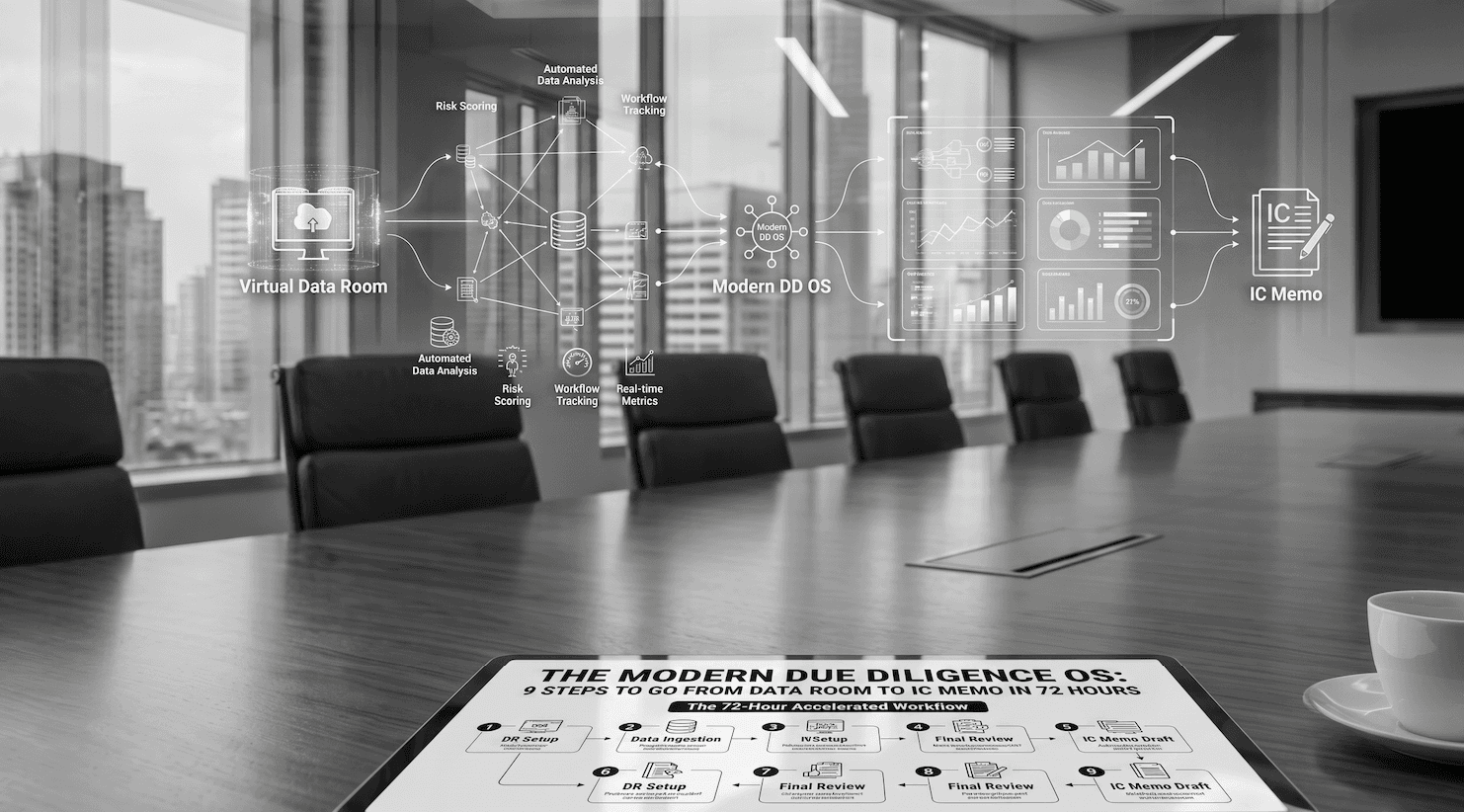
The Modern Due Diligence OS: 9 Steps to Go from Data Room to IC Memo in 72 Hours
Why Traditional Due Diligence Kills Good Deals
Speed-to-conviction is the most underrated competitive advantage in private markets. The ability to form a high-confidence view faster than competitors means more deals seen, fewer lost to faster-moving funds, and less partner time wasted on companies that don't fit the thesis. The 9-step framework below compresses the data-gathering phase so that judgment (team assessment, risk calibration, conviction formation) can begin earlier and go deeper.
The moment an NDA is signed, most teams waste the first few hours on logistics. Standardize this step once and it disappears from every deal after.
Yesterday: Every deal starts with an impromptu Slack conversation about where documents should live, who owns which workstream, and how notes will be organised. The setup overhead repeats on every deal and consumes hours of analyst time before a single document is reviewed.
Today: Deploy a standardized deal workspace template the moment the NDA is signed: pre-defined folder structure by document category (financials, legal, product, customer, competitive), team member workstream assignments, standard diligence question sets by category, and output format for the preliminary findings report. Every document routes correctly from day one.
Tomorrow: Peripheral automatically provisions a fully configured deal workspace the moment a new company is added to the pipeline: pre-loaded with the firm's standard diligence templates, question sets, and workstream assignments, with no manual setup required.
Tools: Notion · Google Drive · Peripheral Projects (workspace template)
The question isn't 'have you read the data room?' The question is 'can you query it?' There's a difference.
Yesterday: An analyst spends two days doing a first-pass review of hundreds of documents, flagging the ones that warrant deeper attention. This triage is time-consuming, incomplete, and dependent on the analyst's experience. Documents in unusual formats are routinely missed.
Today: Batch-upload the data room to a Peripheral Project. Every document: PDF, Excel, PowerPoint, regardless of format is processed into a queryable knowledge base. You can now ask cross-document questions that would take days to answer manually: 'What does churn data show across all uploaded documents?' 'Are there any change-of-control provisions in customer contracts?' 'Is revenue recognition policy consistent across the financial statements?'
Tomorrow: Peripheral continuously monitors the data room for new document uploads throughout the diligence process, automatically ingesting, indexing, and cross-referencing additions against existing materials the moment they arrive.
Tools: Intralinks · Datasite · DocSend · Peripheral Fortress + Projects
You don't need to rebuild the model. You need to identify the 3 assumptions that the board will probe. AI finds them in minutes.
Yesterday: Analysts spend four to eight hours building a parallel model or reconciling the management model against historical actuals. Key assumption deviations are identified through manual inspection, and the questions for the management call are based on whatever the analyst happened to notice.
Today: Upload the financial model alongside historical financial statements and board-level reporting. Peripheral cross-references model assumptions against historical actuals: where does the forecast growth rate diverge from history? Where does the gross margin trajectory differ from the actual trend? What does the implied CAC in the model compare to historical data? The output is a prioritized anomaly list; the questions worth asking in the management meeting.
Tomorrow: Peripheral benchmarks the model assumptions automatically against comparable company data and public market benchmarks - flagging not just internal inconsistencies but assumptions that are aggressive relative to what the market actually supports.
Tools: Excel · Google Sheets · CapIQ · Peripheral Metrics + Claim Validation
Outside counsel at $500/hr should be reviewing legal issues, not conducting a first pass that AI can complete in 20 minutes.
Yesterday: Outside counsel reviews the full contract set, billing for comprehensive review regardless of which documents contain material issues. Legal spend is front-loaded and the most material issues are often identified only in the second or third review cycle.
Today: Run the key legal documents through Peripheral with a specific brief: flag change-of-control provisions in customer contracts, IP ownership ambiguities, non-compete gaps affecting the founding team, and pending litigation mentions. The output is a prioritized risk list. Share it with outside counsel before their first review: directing billable hours toward material issues identified, not discovered.
Tomorrow: Peripheral maintains a living legal risk register throughout the diligence process, automatically updating as new documents are added to the data room and flagging any changes that affect previously identified risk items.
Tools: Harvey · Peripheral Projects · Kira Systems
Every CIM contains assertions presented as facts. Some are well-supported. Some are not. AI finds the gap before the board meeting does.
Yesterday: Management assertions about TAM, competitive positioning, and customer metrics are accepted at face value or challenged based on the analyst's existing market knowledge. Systematic cross-referencing against external data rarely happens — there isn't time.
Today: Feed the CIM or management presentation into a Peripheral Project alongside external data: PitchBook for TAM claims, public filings for competitive context, analyst reports for market growth rates. Peripheral flags assertions that are unsupported or inconsistent with external data, not a verdict on intent, but a prioritized list of claims that warrant deeper verification before the investment decision.
Tomorrow: Peripheral runs claim validation continuously as new documents and market data arrive, automatically updating the risk register when a new data point contradicts or strengthens a management assertion made earlier in the process.
Tools: PitchBook · Bloomberg · Peripheral Claim Validation · AlphaSense
The difference between a good management meeting and a great one is the specificity of the questions going in. Here's how to always have specific questions.
Yesterday: Investors walk into management meetings with a generic question list built from a quick scan of the CIM. The conversation is exploratory rather than diagnostic. Red flags surface only if management volunteers them or the investor happens to probe the right area.
Today: The management call brief from Peripheral includes: the financial metrics that showed the most meaningful deviation from trend, the model assumptions most in need of validation, the legal issues flagged in document triage, and the market claims not fully supported by external data. Every question is context-specific and evidence-based. The meeting becomes diagnostic rather than exploratory.
Tomorrow: Peripheral generates a dynamic management call brief that updates in real time as new diligence outputs arrive, so the question set evolves automatically between when it is first generated and when the call actually takes place.
Tools: Peripheral Insights · Fireflies.ai · Granola
The diligence call is the most information-dense moment in any process, and the most poorly documented. Here's how to fix that without adding a single extra step.
Yesterday: Notes taken during diligence calls are incomplete by definition. The analyst is too busy listening to write everything down. Key claims made by management, customers, or experts are partially captured, rarely cross-referenced against the data room, and never systematically followed up.
Today: Configure your AI note-taker (Granola, Fireflies, or Zoom AI) to generate a transcript summary at the end of every diligence call, then auto-forward it to the company's dedicated Peripheral inbox. Peripheral ingests each summary, extracts key claims, and flags any statements that contradict or reinforce what the data room documents already show. By the time the IC memo zero-draft runs, every management call, customer reference, and expert network session has been processed and cross-referenced - not just the ones the analyst had time to write up properly.
Tomorrow: Peripheral cross-references claims made across all diligence calls simultaneously, surfacing contradictions between what management said in week one and what a customer reference said in week three, automatically and without any analyst intervention.
Tools: Peripheral Fortress + Insights · Fireflies.ai · Granola · Zoom AI
For consumer and D2C targets, the most valuable diligence signals aren't in the data room. They're on the shelf. Here's how to bring them into the analysis.
Yesterday: Field observations from store visits or trade shows are captured in informal notes or personal photos that never make it into the formal diligence record. Ground-truth evidence is disconnected from the analytical process and rarely influences the final IC memo.
Today: Associates visiting retail locations or trade shows can photograph product placement, competitor adjacency, pricing displays, and inventory density and upload them directly to the Peripheral Fortress from their phone. Peripheral processes the images alongside the documentary evidence already in the project, cross-referencing what the photos show against management's claims about distribution reach and retail execution. Ground-truth evidence that no data room document can replicate, captured in minutes.
Tomorrow: Peripheral automatically tags and categorises field diligence uploads, linking each image to the specific management claim it validates or contradicts, and surfacing the most material discrepancies in the Insights feed alongside the financial and legal analysis.
Tools: Peripheral Fortress (image upload) · Peripheral Projects
72 hours of AI-augmented diligence has built your evidence base. Now let the system organize it: so you can spend your time on the argument, not the architecture.
Yesterday: An analyst spends two to three days building an IC memo from scratch — pulling from fragmented notes, half-finished models, and documents spread across multiple tools. The first day is mostly organisational. The actual analytical writing happens in the last 12 hours under deadline pressure.
Today: After 72 hours of AI-augmented diligence, all materials live in a single Peripheral Project: the ingested data room, anomaly report, legal triage, claim validation, management call notes, field diligence, and competitive analysis. Upload your firm's IC memo template (or a past memo that reflects your house style) into Peripheral's Project Templates, and Peripheral uses it as the structural blueprint. The zero-draft it generates doesn't just follow a generic format; it follows yours. The partner edits and argues; the system structures and organises in the voice the IC committee already expects.
Tomorrow: Peripheral learns from every IC memo the firm produces, refining the zero-draft output over time to reflect the firm's evolving analytical standards, preferred structure, and the specific risk factors the IC committee weighs most heavily.
Tools: Notion / Google Docs · Peripheral Project Templates
FINAL THOUGHTS
The 72-hour due diligence process isn't a shortcut, it's a reallocation. AI handles data aggregation, pattern matching, anomaly detection, and document synthesis. You handle team assessment, thesis validation, risk calibration, and conviction formation. The firms that implement this consistently don't make faster decisions in the sense of less careful decisions. They make earlier decisions with more information, because the information-gathering phase has been compressed so the judgment phase can begin sooner. In a competitive deal environment where the best companies choose between multiple term sheets, that timing advantage is often the margin of difference.
WHERE PERIPHERAL CONNECTS THE DOTS
Peripheral's Fortress, Projects, Metrics, and Claim Validation features each appear naturally at the point in the workflow where they solve a specific friction point, the connective tissue across a fragmented toolkit.


.png&w=3840&q=75)