← Back to blog
PlaybookPlaybook - Investors
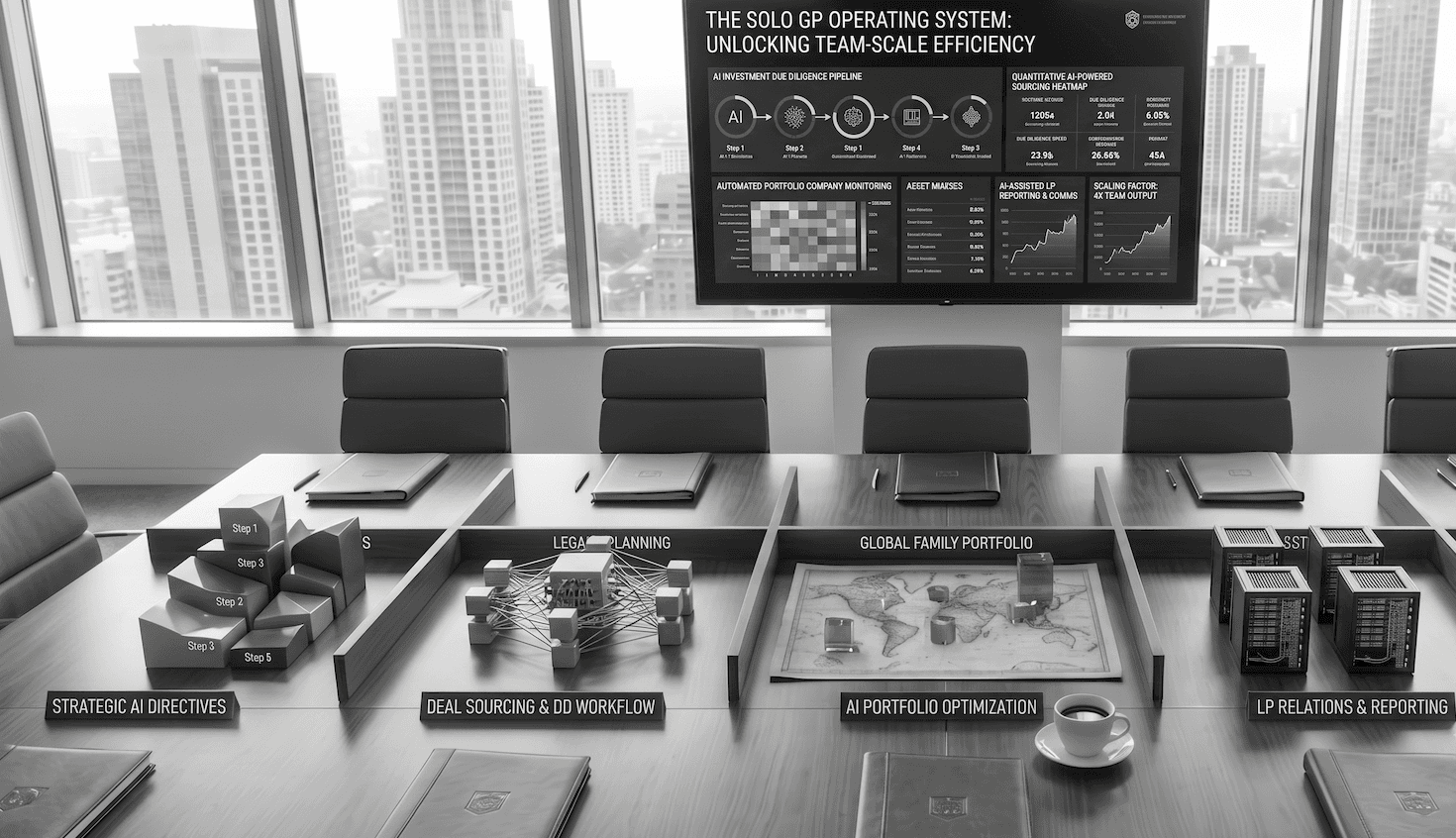
The Solo GP Operating System: 5 AI Steps That Let One Person Run a Fund Like a Team of 4
Why Solo GPs Are Winning Deals That Multibillion-Dollar Funds Can't
Solo GPs are winning deals that multi-billion-dollar platforms can't: because of speed, founder alignment, and conviction depth that no partnership can replicate. The constraint has always been bandwidth. A solo GP is simultaneously running sourcing, managing a portfolio, communicating with LPs, conducting diligence, building a brand, and administering a fund. AI has changed the arithmetic: the leverage that used to require two or three additional team members is now available from a well-configured technology stack.
Without a systematic triage process, high-volume inbound deal flow is the best and worst feature of the job simultaneously. Here's the system that makes it only the best.
Yesterday: 200 inbound deal emails arrive per month in no standardized format. Some have pitch decks attached. Some are LinkedIn messages. The GP reads what arrives, responds to the ones that seem interesting, and misses a meaningful percentage of the actually compelling ones because they arrived at the wrong moment or in the wrong format.
Today: Three-layer architecture: (1) Typeform intake form capturing company name, stage, sector, deck link, one-paragraph description, replacing unstructured cold email with structured data; (2) AI scoring against documented thesis criteria, sorting inbound into three tiers automatically; (3) Tier 1 entries populate Affinity as active opportunities with submission data pre-loaded. The GP reviews strong fits first: 200 inbounds managed in 3 to 4 hours vs. 12 to 15 hours.
Tomorrow: Peripheral monitors inbound signals continuously across email, LinkedIn, and portfolio data feeds, proactively surfacing companies that match the thesis before they formally reach out, turning reactive triage into proactive sourcing.
Tools: Typeform · Airtable · Affinity · Peripheral Projects
The quarterly LP update takes 2–3 days to produce. It should take 90 minutes. Here's the workflow that gets you there.
Yesterday: The GP manually pulls metrics from each portfolio company, reconciles inconsistent reporting formats, writes the narrative from scratch, and finalizes the update under deadline pressure. For a portfolio of 15 companies, this is close to a full week of work every quarter.
Today: Because every portfolio update has been ingested throughout the quarter, the data already exists in structured form. Query Peripheral for highlights, lowlights, and KPI trends by company, each benchmarked against external market comparables so the LP narrative speaks to relative performance, not just absolute numbers. Generate section-by-section first drafts. The GP's role shifts from data-gatherer to editor and voice-injector, adding the context only they can provide. Total time: 90 minutes from data to send.
Tomorrow: Peripheral generates a fully structured LP update draft automatically at quarter end, pre-populated with portfolio performance data, cross-company trends, and external benchmarks, ready for the GP to review, calibrate, and send.
Tools: Peripheral portfolio intelligence · Visible.vc · Notion
Your calendar fills from the outside in. Here's how to reclaim it as a strategic resource allocation tool rather than an aggregation of other people's scheduling requests.
Yesterday: Every inbound meeting request gets manually evaluated and scheduled. Deep-work blocks get crowded out by reactive scheduling. Meeting notes live in a personal notebook or a scattered Notion page, never systematically connected to the company's investment record.
Today: Reclaim or Motion protects deep-work blocks based on stated priorities and automates meeting logistics. Every founder call runs with Granola capture, conversation summarized and synced to the company's Affinity record automatically. The GP's relationship memory is not stored in their head where it's vulnerable to human recall limits, but in a searchable system that surfaces the right context before every interaction.
Tomorrow: Peripheral learns the GP's scheduling priorities over time, automatically protecting the highest-value time blocks and pre-loading context for every upcoming founder call, so the GP arrives at every conversation already current on the company's latest developments.
Tools: Reclaim.ai · Motion · Granola · Fireflies.ai · Affinity
Without an associate to delegate to, diligence is the solo GP's most acute bandwidth constraint. Here's how to compress 3 weeks of process into 5 focused days.
Yesterday: A solo GP running a full diligence process takes three to six weeks. Manual data room review, financial model analysis, legal triage, competitive landscaping, and IC memo writing all compete for the same bandwidth. Running the process on more than one company simultaneously is essentially impossible.
Today: Day 1: data room ingestion and financial anomaly detection. Day 2: legal triage and management call brief generation. Day 3: management call (with AI capture) plus competitive analysis. Day 4: claim validation and IC memo zero-draft. Day 5: partner review, decision, or targeted follow-up. Each day's AI output feeds the next. The GP's 5 days are spent on judgment, conversation, and conviction, not data gathering.
Tomorrow: Peripheral runs the data aggregation and preliminary analysis steps of the sprint in parallel from day one, so that by the time the GP begins their active diligence work, the foundational outputs, financial anomaly report, legal triage, and claim validation flags, are already waiting for review.
Tools: Peripheral Projects + Claim Validation · Crunchbase · CapIQ · Granola
The portfolio company that remembers you most fondly isn't necessarily the one where you contributed the most capital. It's the one where you called before being asked.
Yesterday: Portfolio support is entirely reactive. The GP reads the monthly update when it arrives, responds if something significant is flagged, and engages when the founder reaches out with a problem. The pattern means the GP is always one step behind the company's situation.
Today: KPI alert thresholds fire when a metric crosses a defined level, before the monthly update arrives. When revenue retention starts moving in the wrong direction six weeks before the quarterly board meeting, the GP knows immediately. The proactive call: 'I noticed X trend in your last update, here's a connection that might help' is worth more for the relationship than any capital contribution.
Tomorrow: Peripheral combines internal KPI signals with external market intelligence to distinguish between company-specific issues and broader market trends, so the GP can frame every proactive conversation with the full context of what is happening inside and outside the portfolio company simultaneously.
Tools: Carta · Peripheral Insights + KPI alerts · Affinity (portfolio connections)
The complete AI operating system for a solo GP. Four layers, specific tools, real costs. Take this article and build your stack this week.
Yesterday: Solo GPs cobble together point solutions: a CRM here, a data subscription there, a note-taking app, a shared drive. The tools do not talk to each other. The GP's time is consumed by the gaps between them.
Today: Four functional layers: (1) Sourcing — Typeform intake, Affinity CRM, PitchBook/Crunchbase data (~$33K/yr); (2) Intelligence — portfolio monitoring, diligence, research synthesis (~$8K/yr); (3) Meeting and productivity — Granola, Reclaim, Notion (~$3K/yr); (4) Fund operations — Visible.vc, Carta, AngelList (~$6K/yr). Total: ~$50–60K/yr. Peripheral replaces a meaningful portion of this stack at roughly a third of the total cost, and a fifth of the fully loaded cost of an analyst.
Tomorrow: Peripheral consolidates the sourcing, intelligence, and reporting layers into a single platform, reducing the total stack cost further while eliminating the integration overhead between tools that currently consumes a disproportionate share of the GP's operational bandwidth.
Tools: Full stack: PitchBook · Clay · Affinity · Peripheral · Granola · Reclaim · Visible.vc · Carta
FINAL THOUGHTS
The solo GP with a well-configured operating system isn't a solo GP. They're a lean, focused investment firm with the operational infrastructure of a team three times their size. The leverage gap between a solo GP and a 10-person fund is now closeable with AI, not for the work that requires human judgment, but for everything else. Build the infrastructure. Direct the judgment where it counts.
WHERE PERIPHERAL CONNECTS THE DOTS
Peripheral appears in the due diligence sprint (Projects + Claim Validation), LP reporting workflow (Metrics), and portfolio monitoring (Insights). Framed as the intelligence infrastructure layer that makes the rest of the stack 10x more valuable, the system of record for everything that matters about your portfolio.


.png&w=3840&q=75)